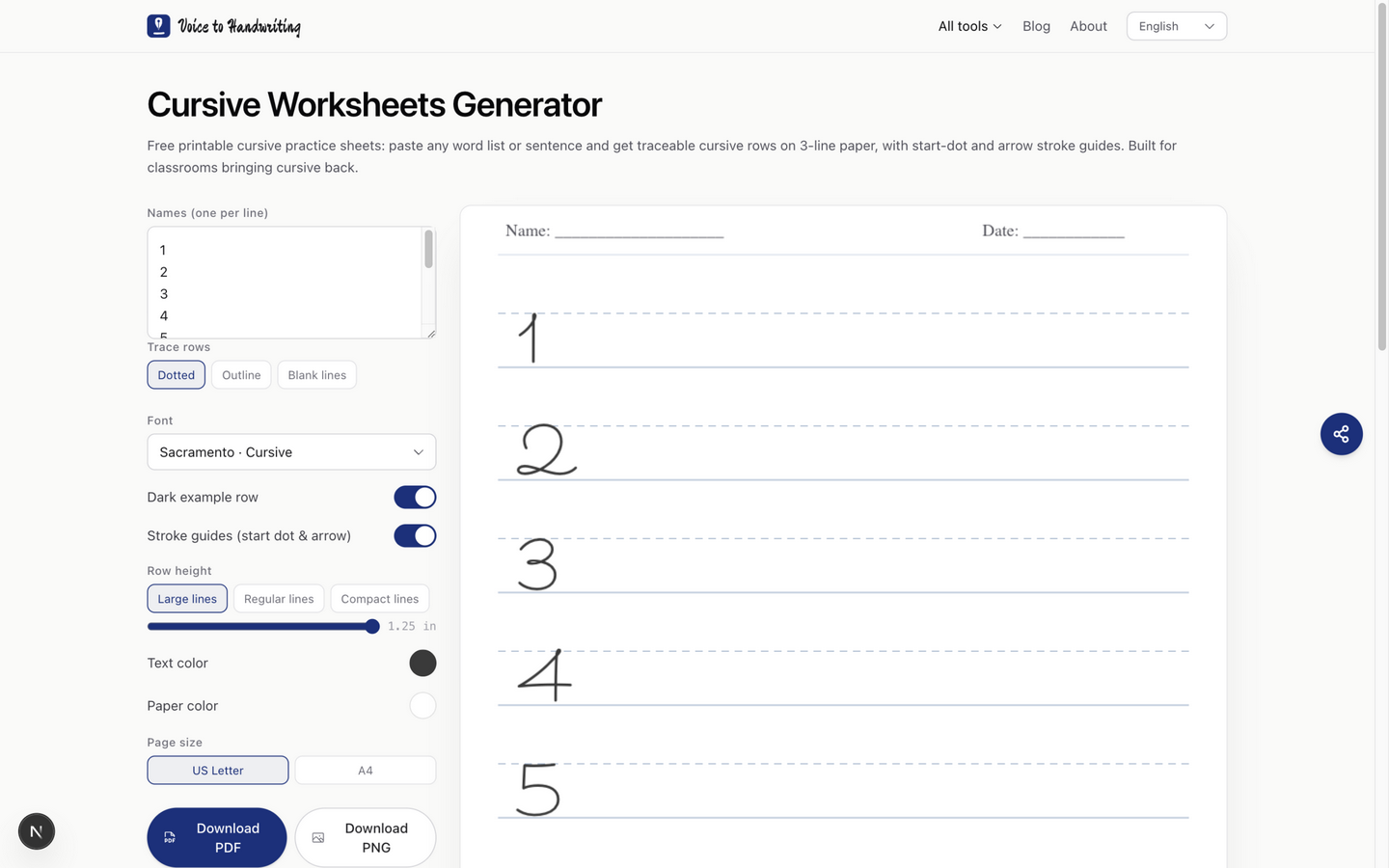
Numbers in cursive: what 1 to 10 look like and how to practice them
Sooner or later, the cursive unit reaches the page numbers live on, and a hand goes up: "Do numbers join too?" It is a fair question — cursive letters hold hands across the word, so why not 2 and 3?
The short answer, in the styles most classrooms use: no. Numerals stand alone, even in the middle of a cursive sentence. That is not the child missing a rule — it is the rule. Here is what cursive numerals actually look like, and a practice page you can print in two minutes.
What cursive numerals look like
The pleasant surprise is how familiar they are. In Sacramento, the cursive font on our practice pages, most numerals are the print forms everyone already knows, drawn with a cursive slant. The loop — the thing that makes cursive look like cursive — shows up in only a few of them.
| Numeral | What it looks like in cursive |
|---|---|
| 1 | A plain slanted downstroke. No base serif, almost no flag. |
| 2 | The familiar curve, with a small loop tucked into the baseline before the tail runs off. |
| 5 | Print-shaped: flag on top, open bowl. It does not close into a loop. |
| 7 | A slanted downstroke with a top arm — and no crossbar in this font. |
| 8 | A narrow loop stacked on a rounder one, like a tiny figure eight drawn in one motion. |
Two honest caveats. First, numerals vary more between cursive styles than letters do — a 7 with a crossbar is correct in some workbooks and absent in others, and neither is wrong. Second, fonts are not workbooks: ours are open-source handwriting styles chosen for clean shapes, not a penmanship curriculum. If your school's book draws a numeral differently, the book wins.
Each numeral also has its own step-by-step lesson on this site — where the loops sit, the mistakes that show up on the page, and a printable strip. Start with the ones that fight: 2 in cursive, 7 in cursive, 8 in cursive.
The two-minute practice page
The cursive worksheets generator takes any list, numerals included. This link opens it with 1 through 10 already typed, one per line: cursive numbers, ready to print.
- The page opens on large lines, which is right for a first meeting with slanted numerals. Switch to regular lines once the loops settle.
- The first pass through the list prints solid to copy; the rows under it print dotted to trace.
- One numeral per row is not lazy — it is the point. Each numeral gets the full row width, so there is room for the slant to grow without crowding the next digit.
One limitation to know before you print: the green start dots work for letters, not numerals. A digit row shows the model and the dotted lines, but no dot marking where the pencil lands. If your writer depends on that dot for letters, sit for the first row of numerals and mark the start with your finger.
If the print numerals are still wobbly
Slanting a numeral the child cannot yet draw reliably just teaches the slant on a broken shape. If 8 still comes out as two circles that miss each other, or 5 loses its flag, stay with print numerals for now — the number tracing pages by age cover that path. Cursive numerals keep. Print shapes are the foundation they sit on.
Counting stays at the table
A worksheet rehearses the mark, not the meaning. A child can trace a beautiful row of 8s and still miscount a plate of crackers. Keep the numerals on the page and the quantity in the conversation — which is one more reason the list runs 1 to 10 and stops there.