How to make handwriting worksheets for a whole week, tonight
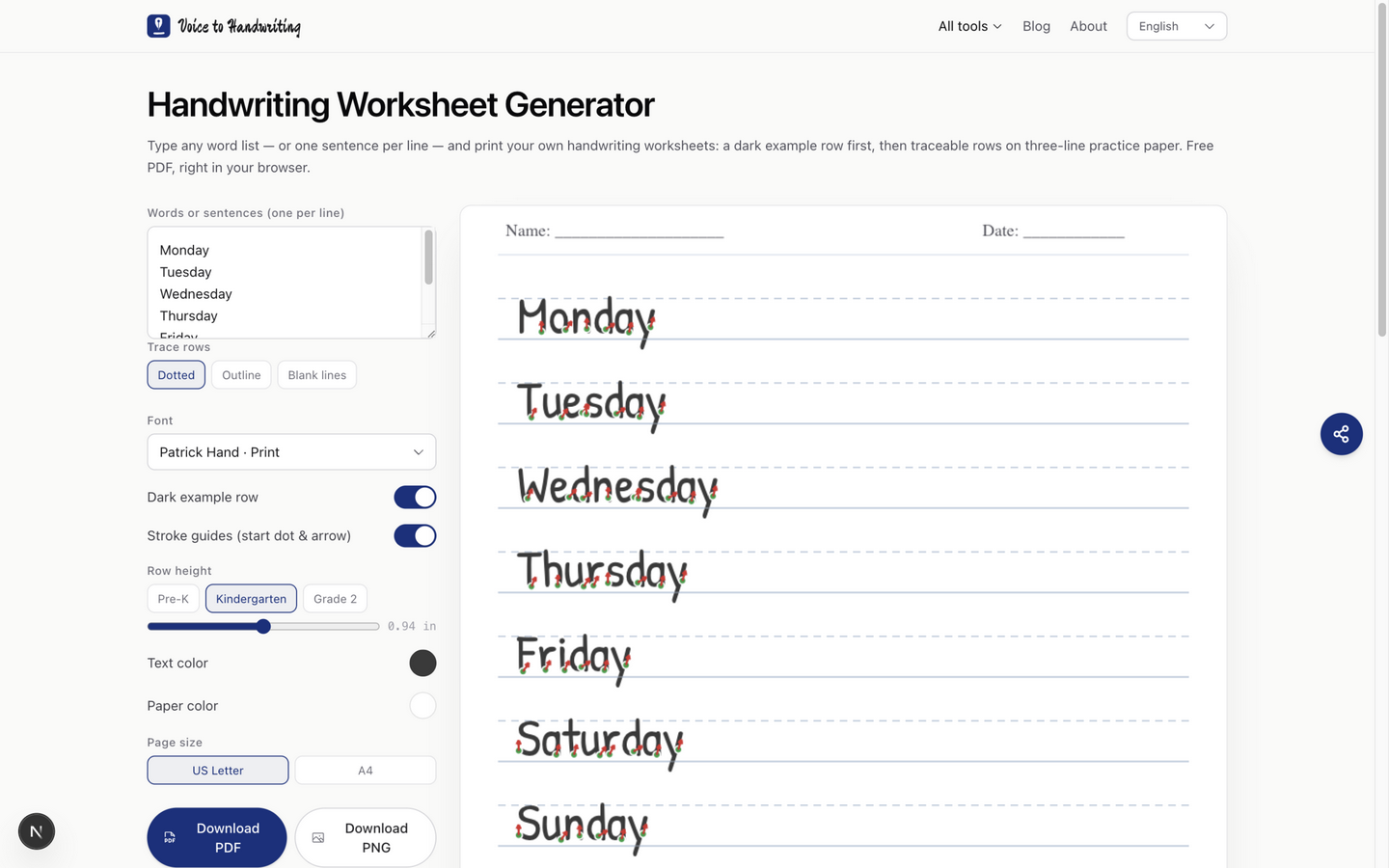
Sunday, 9 pm, and the printer is the only thing standing between you and Monday morning. The handwriting worksheet generator makes this a five-minute job: type the words, pick the row height, print the PDF. The page even opens with the days of the week already typed, so the laziest correct move is to print that one and call it Monday.
Here is the version I give parents at our table and teachers setting up morning work: build all five sheets tonight, in one sitting, before the week starts making decisions for you.
Build one sheet in four steps
- Open the generator and type your list — one word per line, or one short sentence per line. The first pass through your list prints as a solid row to copy; every row after it prints dotted to trace. That is the whole mechanic, and it is the right one: the child copies once, then traces the same words four or five more times.
- Pick the row height. Kindergarten rows for ages 5–6, Grade 2 rows for ages 7+. Pre-K rows are there for a 4-year-old who insists on joining in — give them their name, not the alphabet.
- Leave the dark example row on. It is the row the child's eye returns to when the dotted rows drift.
- Download the PDF and print at actual size. US Letter or A4, whichever your printer eats.
Nothing you type leaves the browser, so a class list of names is as safe as a spelling list.
What goes on the line, by age
| Age | On the line | The fight you are preventing |
|---|---|---|
| 3–4 | Their own name, one word, Pre-K rows. Letters can wait. | A 3-year-old asked to trace the alphabet learns to scribble over dots. |
| 5–6 | Three to five words from this week's story. Keep them short. | Too many new words turns tracing into copying shapes with no sound attached. |
| 7+ | One short sentence per line — a fact from the book, a plan for the weekend. | Long lists of bare words at this age feel like punishment, not writing. |
The sentences matter more than they look. A child who writes "The fox ran to the log" every day for a week owns eleven words and one full stop by Friday.
Five lists for five days
| Day | List |
|---|---|
| Monday | Days of the week — already typed when the page opens |
| Tuesday | Three to five words from Monday's read-aloud |
| Wednesday | Color and number words: red, orange, three, eight |
| Thursday | One sentence about Wednesday's book, one per line |
| Friday | The child picks five words, then free-writes on blank paper |
Friday is the payoff, and it needs a different page. When the tracing sheet is done, hand over a sheet from the printable paper set — plain ruled, no model — and the child writes anything. The whole point of four traced days is a fifth day where nobody traces.
If the sheet comes back half-finished
Half-finished is fine. The job is one solid row copied and two dotted rows traced; if that is what tonight gave, the sheet worked. Swap the pencil for a crayon when grip turns into a fist — the dots do not care what marks them. And stop while the child still wants one more turn; the generator prints tomorrow's sheet in ninety seconds, so there is no reason to ration.
If the fight is really about the words — a child who can't read the list can't own the list — shrink to word-family chunks: cat, hat, sat. Same sheet, same rows.
What these sheets will not do
The font is Patrick Hand, an open-source print style, not your school's teaching script — a few letterforms will look slightly different from the wall chart. There are no numbered stroke arrows, so a child who draws an l from the bottom up will keep drawing it that way; that is a watch-and-model job, not a worksheet job. And for names — a sheet with one name per page, grade-sized rows, is the name tracing generator's exact job. Same list in connected script belongs to the cursive worksheets generator.