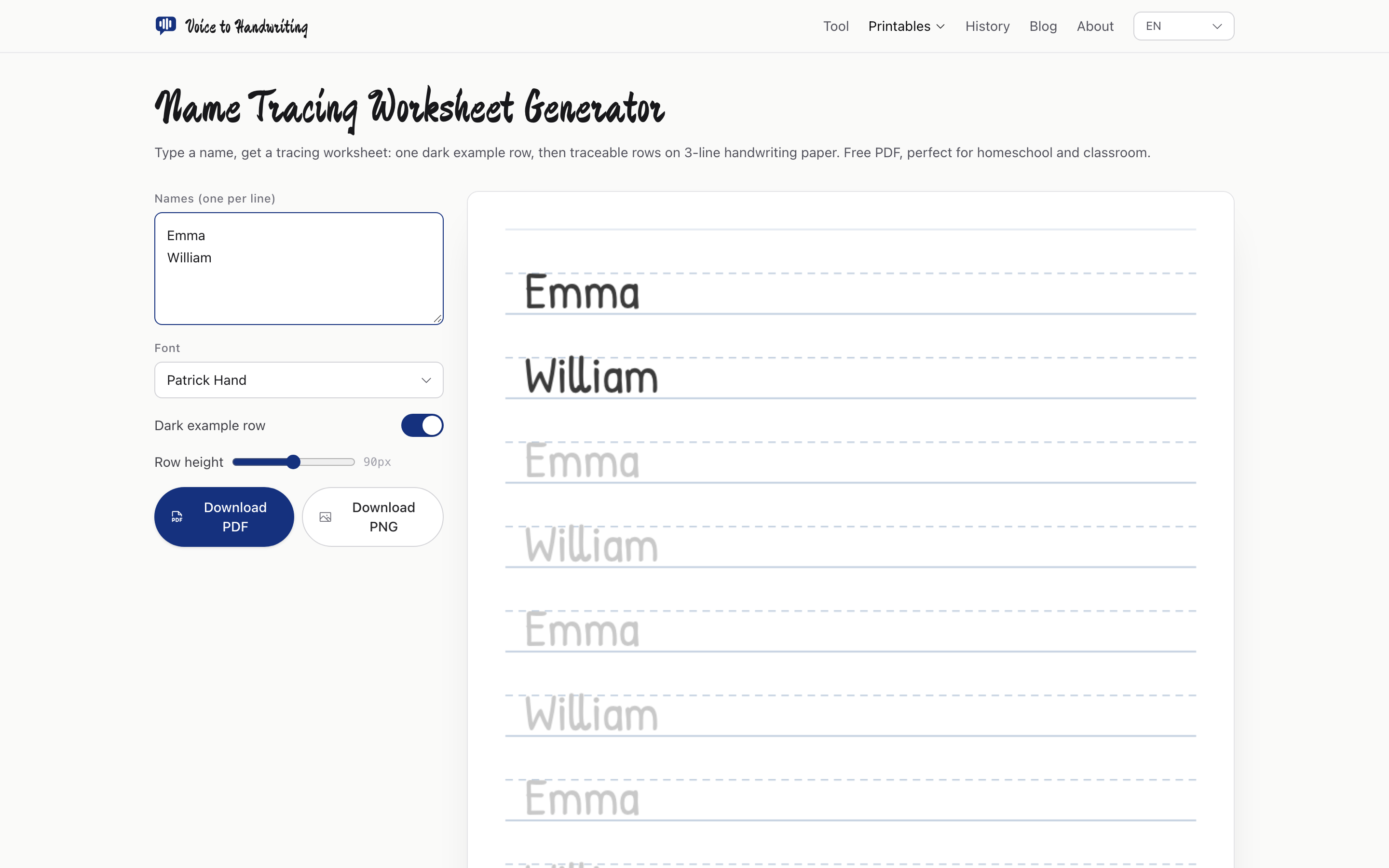
Name tracing generator: personalized worksheets in 60 seconds
A child's name is usually the first word they learn to write — it's theirs, it matters, and it gets practiced more than anything else on the worksheet wall. That's why name tracing works when generic letter drills don't.
Most "editable name tracing" printables you'll find are PDFs you can't actually edit, or apps that watermark the free tier. Here's how to make a personalized tracing worksheet with a free name tracing generator — no signup, no watermark, print-ready PDF.
Make one in three steps
- Open the name tracing generator;
- Type one name per line — "Emma", then "Liam", then "Olivia" if you're prepping for the whole class;
- Pick a font, adjust the row height, and hit Download PDF.
For a single letter instead of a name, open the letter tracing worksheets. Each page says where that letter starts and opens a sheet with the letter already filled in.
That's it. The page fills with three-line writing bands: your child's name printed dark as an example row, then repeating in light gray underneath to trace over.
What the worksheet looks like
| Element | What it does |
|---|---|
| Top line (light) | Ceiling — tall letters like b, k, T touch it |
| Dashed middle line | Waist — marks where lowercase bodies end |
| Solid baseline | Floor — every letter sits on it |
| Dark example row | Shows the name correctly formed, once per cycle |
| Light gray rows | The tracing target — pencil over gray |
The row height slider (60–120px) is the difference between a worksheet a 4-year-old can use and one that frustrates them. Start big: 100–110px for preschool, 80–90px for kindergarten, smaller for first grade review.
Picking the font
- Patrick Hand — clean print-style letterforms, the closest match to how teachers model letters;
- Kalam / Indie Flower — slightly rounder and friendlier, good for reluctant writers;
- Caveat / Cedarville Cursive — for cursive name practice in 2nd–3rd grade (yes, cursive is coming back in many state standards).
One honest note: the tracing letters are solid light gray, not dashed outlines with stroke arrows. For most kids that's fine — they trace the shape. If your child needs numbered stroke prompts, this generator won't provide them; pair it with letter-formation cards.
Classroom trick: the whole class in one file
Type each student's name on its own line. The generator loops through every name to fill the page — each name gets one dark example row followed by light gray tracing rows. Print one copy per student and highlight their row, or slice the page into strips for morning work.
For kindergarten handwriting practice beyond names, pair it with free printable three-line handwriting paper — same three-line system, blank, for the rest of the alphabet.
Tested, with honest limitations
- Works in any modern browser; the PDF is US Letter size (8.5×11") — A4 users should print at 100% scale and trim, or expect slight margins;
- Fonts are open-source handwriting fonts, not the exact style of any commercial curriculum (Zaner-Bloser, D'Nealian etc.);
- Nothing is uploaded — the worksheet renders in your browser, and no names are stored on a server;
- Free, no account, no watermark.
People also ask
- Is this name tracing generator really free? Yes — fonts are open source, everything runs in your browser, and there's no signup.
- Can I make tracing worksheets with dotted letters? The tracing letters are light gray rather than dashed outlines — designed to be traced over with pencil.
- How do I make a cursive name tracing sheet? Choose Dancing Script or Cedarville Cursive in the font menu — see cursive practice worksheets.
- What age is name tracing for? Typically ages 3–6: start with just the first name in large rows, add last name once the first is consistent.