How to write in cursive: a beginner's guide that works
Most cursive tutorials hand you an alphabet chart and wish you luck. That skips the only two things that actually make cursive click: consistent slant, and letters that share strokes. Learn the strokes first and the 26 letters become six or seven small variations — not 26 separate problems.
This is the sequence handwriting teachers use, adapted for adult self-teachers. Type any word into the cursive writing generator as you go, print it, and trace — the whole setup costs nothing.
Start with the four strokes, not the letters
Every lowercase cursive letter is built from four moves:
- Undercurve — the "uphill ramp" you enter most letters with, like a shallow u shape;
- Downstroke — the main vertical pull, done in one smooth motion (this is where your slant lives);
- Overcurve — the "hill" arch you exit with, like a shallow n hump;
- Connector — the little tail at the baseline that hands off to the next letter.
Fill a few lines with each stroke alone — ramps, pulls, hills — before writing a single letter. If your downstrokes all lean the same way after ten minutes, you've done the hard part.
Learn letters by family, not by alphabet order
| Family | Letters | The shared move |
|---|---|---|
| Ovals | a, c, d, g, o, q | Start with an overcurve into a round "c" shape |
| Waves | i, t, u, w, e | Up-and-down sawtooth strokes |
| Bumps | n, m, h, b, r, p | An arch (or two) planted on the baseline |
| Loops | l, f, k, j | A tall (or diving) loop on the downstroke |
| Odd ones | s, v, x, y, z | Individual shapes — save for last |
Practice families back-to-back: c, a, d, g, o, q in one sitting teaches you that they're all the same circle with different exits. Going a→b→c alphabet order teaches you 26 unrelated shapes.
The connection rules (this is what makes it "cursive")
- Lowercase letters connect at the baseline through their exit tails;
- Four letters finish high and connect awkwardly: o, b, v, w. Let them stand alone or start the next letter fresh — fighting their connectors is the #1 beginner frustration;
- Keep one consistent slant (anything from 0° to ~5° is fine). A mixed slant reads as messy even when every letter is correct;
- Spacing between words should fit a pencil tip — connected handwriting gets crowded fast.
The 30-day beginner plan
- Week 1: the four strokes + the oval family. Five minutes of warm-up strokes, then two letters a day;
- Week 2: waves + bumps families. Start writing real small words: it, in, at, an, on;
- Week 3: loops + odd ones, then all 26 lowercase in random order. Write your name and your city every day;
- Week 4: capitals (they don't connect as strictly — treat them as fancy cousins of print letters), then full sentences.
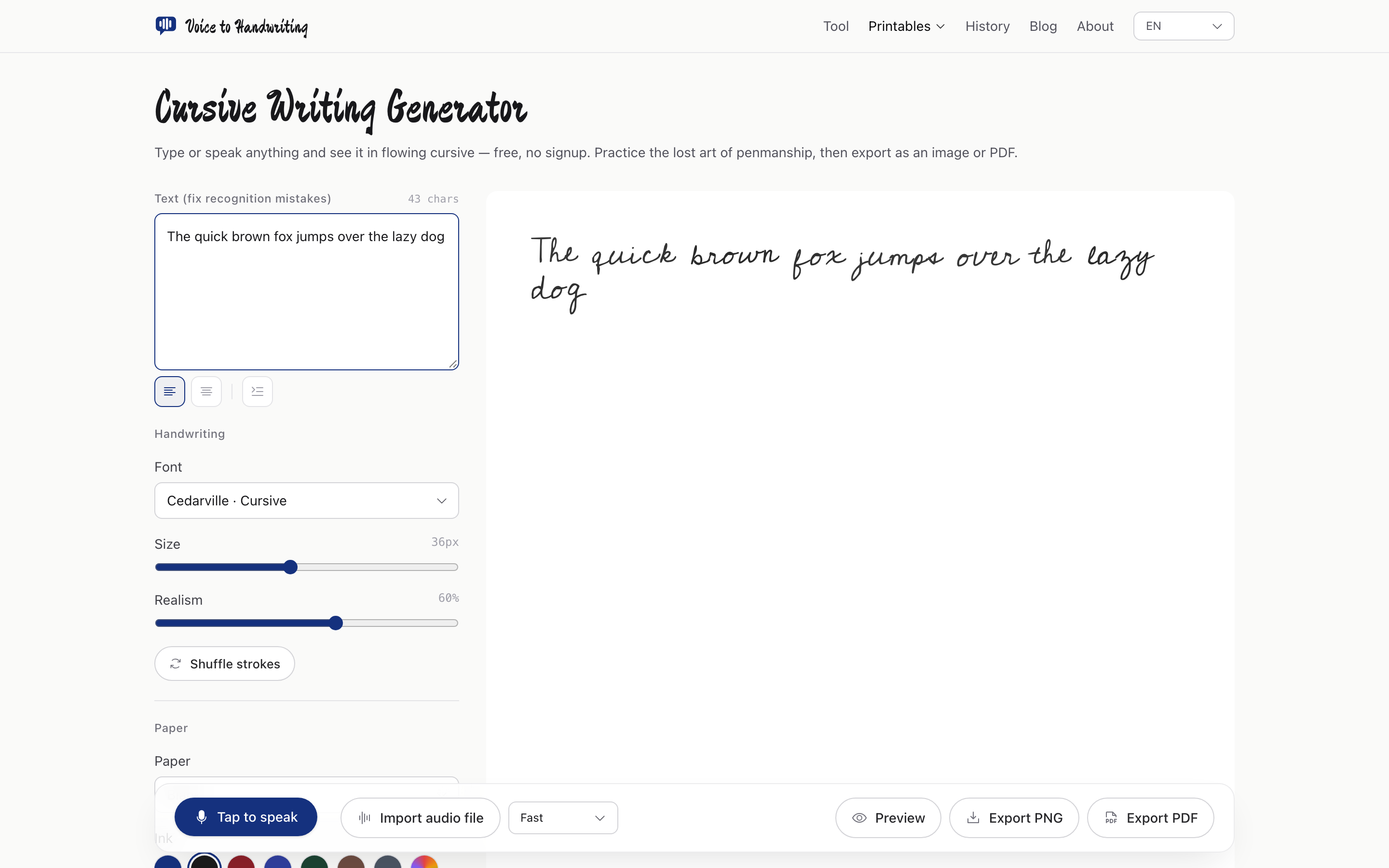
A practical drill that speeds everything up: type a pangram like "The quick brown fox jumps over the lazy dog" into the cursive generator, print the page, and trace it once, then copy it freehand twice underneath on printable lined paper. Trace → copy → compare beats pages of mindless loops. Once the strokes feel natural, the cursive worksheets generator builds you proper practice sheets — any name, word list, or letter family on three-line guides.
Tested, with honest limitations
- The generator uses real open-source cursive fonts — Cedarville Cursive for everyday penmanship, Dancing Script for formal flourish. Letterforms are close to everyday cursive but don't follow a specific school curriculum style (Zaner-Bloser, D'Nealian), and there are no stroke-number arrows;
- Downloads are free PDFs with no watermark, rendered in your browser — nothing you type is uploaded;
- Expect wobbly output for two weeks. That's the schedule working, not you failing.
People also ask
- What is the easiest way to learn cursive? Strokes first, then letter families (not alphabet order), then connections — with daily 10–15 minute practice rather than weekly marathons.
- How long does it take to learn cursive? Most adults write readable cursive within 3–4 weeks of short daily practice; fluid, automatic cursive takes a couple of months.
- Should I learn lowercase or uppercase cursive first? Lowercase — it's 95% of what you write. Capitals are less standardized and can wait a couple of weeks.
- Do all cursive letters connect? No — o, b, v and w end high, and most handwriting styles let the next letter start fresh after them.