Handwriting help for struggling writers (without the tears)
Some kids fight every handwriting session: the pencil grips white-knuckle, the letters shrink or explode, the worksheet ends in tears — theirs or yours. If that's your evenings, the problem usually isn't effort or attitude. It's that standard practice asks for too many skills at the same time.
This piece collects the adjustments occupational therapists and SPED teachers commonly suggest for practice at home — bigger targets, lighter marks, shorter sessions — and how to make worksheets that fit. (One thing up front: this is general practice advice, not medical guidance. If you suspect dysgraphia, ask your school's OT team or pediatrician for an evaluation.)
Why "just practice more" backfires
Handwriting is a stack of separate skills: forming the idea, holding the pencil, recalling the letter shape, and executing it — all at once. Struggling writers overload on the stack, not on any single skill. The adjustments below each remove one thing from the stack so the remaining skills can be practiced calmly.
Five adjustments that change the session
1. Make the target huge — then shrink it slowly. Standard 1st-grade paper is too small for many struggling writers. Print handwriting paper with taller bands (the band height slider goes well beyond worksheet-standard), and shrink the size only when the current one is comfortable. A letter that fits feels like success; a letter that doesn't feels like failure, every line.
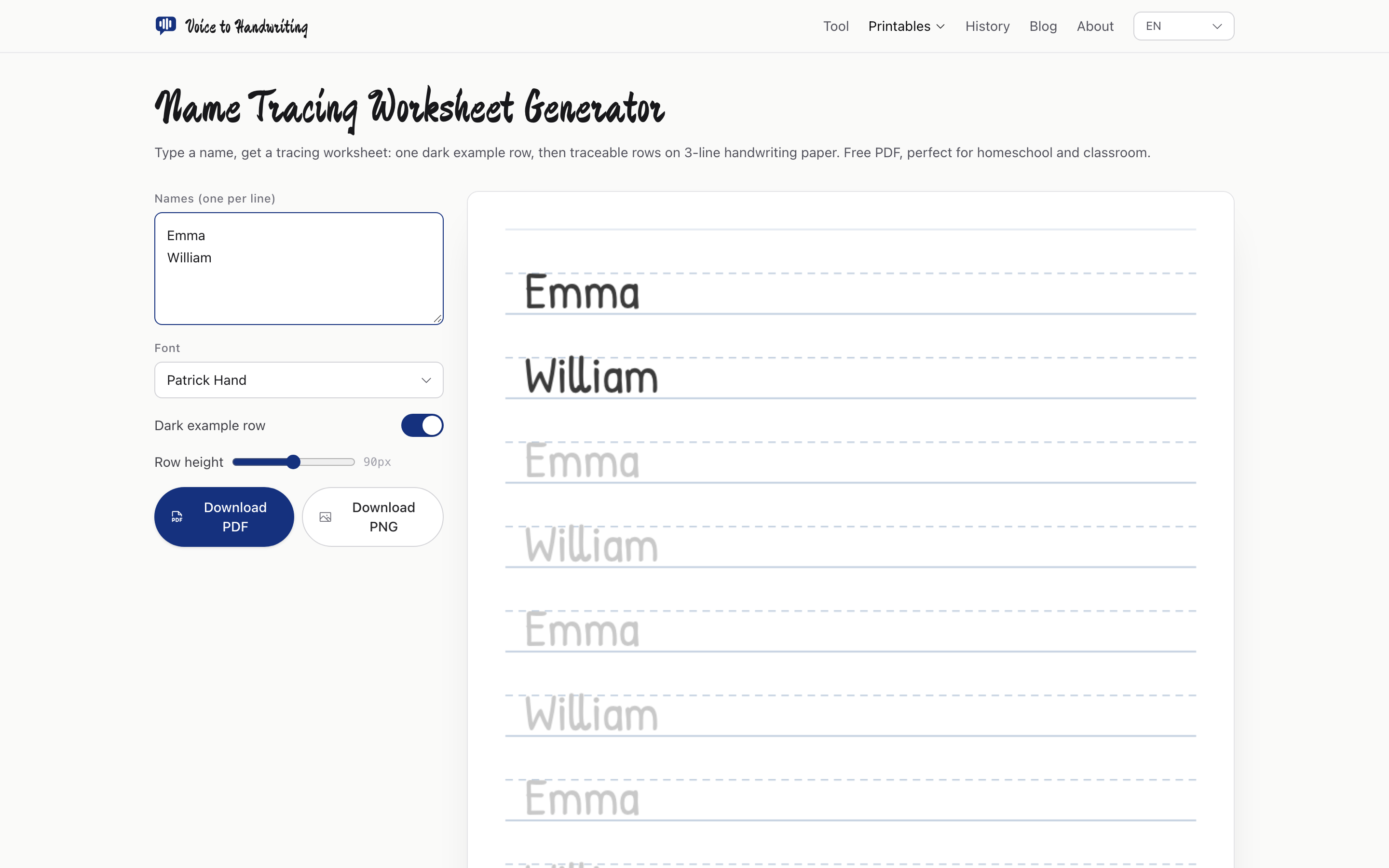
2. Separate the words from the writing. Don't make them think of a sentence and write it. You supply the words: ask what they want to say to Grandma, type their exact words, and print them — either as a model to copy or, with the name tracing generator, as light gray tracing rows on three-line guides. Composition and transcription get practiced separately, and both succeed.
3. Trace before you copy — but keep tracing sessions short. Tracing rows are low-stakes: there's a right answer under the pencil. Two or three traced words, then one freehand copy, then done. Quality of attention beats rows completed; a 5-minute good-tempered session outworks a 20-minute battle.
4. Let the pencil rest. Chunky pencils, pencil grips, or a fatter pen barrel reduce the grip force that tires small hands. Hand fatigue that shows up within minutes is a setup problem, not a motivation problem.
5. End on success, every time. Circle the best letter — not the worst. The last thing your child remembers about handwriting should be a circled good one.
The voice option: when writing really is the enemy
For kids whose handwriting is far behind their ideas (common with dysgraphia), voice input is the pressure release valve. The handwriting tool turns spoken words into a written page in a handwriting style: your child dictates a story or a letter, and sees their words exist in written form — on paper, in their hands — while their hand skills catch up at their own pace. It runs in the browser, nothing is uploaded, and it prints as a real page they can keep or give away.
Written output matters; the order and pace in which kids get there can flex.
Tested, with honest limitations
- The tracing letters here are solid light gray, not dashed outlines with numbered stroke arrows — for most overwriting practice that works; some kids do better with arrows, which commercial OT workbooks provide;
- Adjustable band height, gray rows, and short custom sheets are genuinely free here — no signup, nothing stored on a server;
- Again: persistent struggle, pain, or extreme avoidance deserves a real evaluation, not just better worksheets.
People also ask
- What is dysgraphia? A learning difference that affects written output — handwriting, spelling, and getting ideas onto paper. Evaluation and support go through your school's OT/special-education team or a psychologist.
- What kind of paper helps struggling writers? Paper with extra-tall three-line bands — top line, dashed middle, solid baseline — so letters have an obvious home. Height should shrink gradually as control improves.
- Is tracing good for dysgraphia? Tracing reduces the recall load and lets kids rehearse movement patterns; keep sessions short and pair each traced word with one freehand attempt.
- Should kids with dysgraphia learn to type instead? Typing is a legitimate accommodation, not a cop-out — but handwriting stays worth practicing at the child's pace, in short, low-pressure sessions.