Graphisme: the pre-writing patterns French maternelle trains before writing
In September, in the petite section, nobody asks a three-year-old to write. They ask for lines: down, across, around. That is graphisme — the pattern work that fills French maternelle classrooms, and the real preparation for handwriting long before the first cursive word in CP (first grade).
Here is how the gestures progress from PS to GS, which stroke to train at which age, and how to print a practice sheet in five minutes when tomorrow morning needs one.
What graphisme actually trains
Graphisme is the set of strokes that will later compose letters. A pont (an arch) becomes the n and the m. A boucle (a loop) becomes the e and the l. A round becomes the a, the d, the g. When a four-year-old fills a page with waves, the point is not decoration: it is pencil pressure, the rhythm of the arm, and the control of the stop.
It is not early calligraphy either. In maternelle, nobody corrects "beautiful handwriting" — the school builds the movements that make it possible later. The word that matters is gesture before shape.
The strokes, section by section
| Section | Age | What to train | What to avoid |
|---|---|---|---|
| PS | 3–4 | Big patterns: vertical and horizontal lines, large circles, with thick markers or a finger | Small boxes and thin pencils, asked for too early |
| MS | 4–5 | Waves, arches, first loops; the three-finger grip settles in | Correcting pressure instead of letting the hand regulate it |
| GS | 5–6 | Loops and arches chained in rhythm, spirals, patterns between two lines | Demanding formed cursive: that is CP's job |
Progression matters more than content: every GS gesture rests on a PS gesture that has turned into confidence. A child who only made big circles at three has lost nothing — they redo the work at five with more control, and that is normal.
The five stroke families
- Lines — vertical, horizontal, slanted. They prepare the batons, the backbone of capitals and stick letters.
- Waves — the line that undulates without lifting the pencil. This is the continuous rhythm of writing: the hardest to acquire, the most useful.
- Arches — the shape that rises and comes back down. Two chained arches, and a child holds an n; they also carry the m and the h.
- Loops — the queen of the GS year. Rising loops, descending loops: French cursive is full of them, from e to l.
- Spirals — the stroke that turns without stopping. They train radius control: tighten, release, without lifting.
Make a practice sheet in five minutes
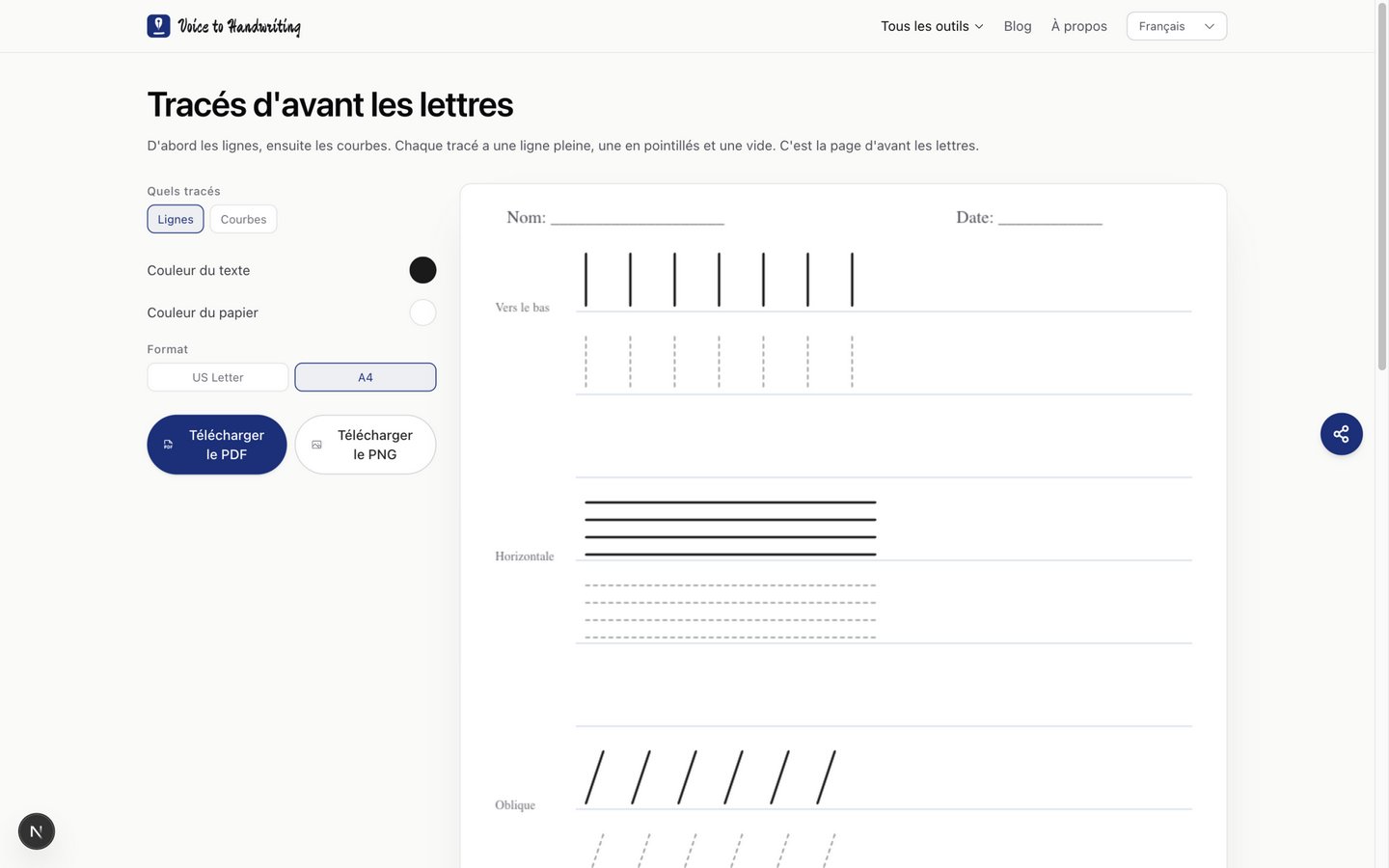
When tomorrow needs a sheet, the prewriting strokes generator does the job: pick the line family or the curve family, set the row height, and the page prints three rows per stroke — a solid model row, a dotted row to trace, and an empty row to try alone. Download the PDF; nothing to install, no account.
Stay in a large format at the start: one or two strokes per page, not fifteen. And for what comes after — once the gesture is acquired and the child writes freely — printable paper takes over with plain ruled pages, no model.
If the child leaves the table
Cut the quantity before cutting the difficulty: three good waves beat a page of sloppy ones. Go back to large format and vertical strokes — on a whiteboard, with water and a brush, whole arm. Between pencil sessions, slip in motor work off the page: play dough, tweezers, spooning seeds. The hand is built away from the sheet as much as on it.
And always stop while the child still wants another turn. The sheet reprints in ninety seconds; the willingness does not.
What graphisme is not
It is not advanced writing: in PS, a child who writes their name in capital stick letters is on time, not behind. It is not a promise of beautiful handwriting — some gestures take months, and that is the normal pace. And it is never a punishment: waves handed down as a sentence only produce resented waves. Keep the gesture for the morning, when the hand is fresh and the appetite for one more try is still there.